All you 2013 runners are about to set off. There is nothing more you can you other than try to relax. And stop packing your bag again! You've got all you need. Plus you will do it all again in day zero at camp trust me.
Enjoy camp life. I was really worried about the whole living via very basic means but I loved it. The site of those black bivouacs in the distance is pure joy after a day in the sand.
You may make friends for life. You'll certainly make friends for the week. MDSers are one of a kind. And don't forget to thank all those volunteers that make MDS happen every year. They really made the difference for me out there. Always smiling. Even better when holding out a cup of mint tea for you.
Manage yourself. Go steady on at least the first day to gauge how your body will react to the conditions. Aim to get to the start of the long day in good shape - feet, body and mind - and you will smash it!
Embrace the pain of the Sahara. She's well worth it. Bon voyage.

To run is fun. To blog about the jog is even better.
Showing posts with label MDS training. Show all posts
Showing posts with label MDS training. Show all posts
Wednesday, 3 April 2013

Friday, 15 March 2013
Marathon des Sables: mental preparation
Even if you are the most positive person in the world, all runners know there are periods in races or training runs where your mind will tell you negative things like "you can't do it", "you don't want to do it", "it's too painful", "I can't go any further".
Out in the desert, staring down the barrel of another 15 miles with a feet looking like mincemeat and your heart hammering in your chest, you'll probably experience a few negative thoughts here too.
Preparing mentally for MDS is slightly different to a shorter race. Shorter races tend to be based on speed. I'm then more concerned with the lactic acid pain that comes with that, combating nerves in the first part of the race, and keeping on going when my body is screaming to stop. Preparing for MDS is more about dealing with carrying on and coping with possible physical pain, dealing with boredom, and the biggy, just finishing running 155 miles carrying 10 or so kg. It's quite a feat that does make your head pop!
You probably already have a way of dealing with any negative thoughts that may pop into your head. Here's my tuppence;
1) Thoughts of pain. I try to concentrate on exactly what the feeling is all about - I become curious about it rather than fear it. Is it sharp, dull, does it hurt all the time, just on weightbearing etc. I try to imagine pain as not to be something that is feared, but to embrace it as part of the spirit of feeling alive and doing something bonkers like MDS.
As well as the somewhat mumbo jumboness of thinking about what pain really is, I also deal with pain on a practical level. If I can manage it as best I can, I will be in control. Pain will not beat me. I win. Positive thought.
2) Thoughts of not being able to finish the race. This happened a few times to me out there, usually when it was combined with thoughts of pain (see above). I was lucky enough to run with my better half. If you can stick alongside a few MDS buddies, they will pick you up mentally throughout the race. A bit of banter lasts for miles!
Otherwise I tended to break down the race into much more manageable sections and plan "rewards" when I reached points. MDS has checkpoints roughly every 10k, which were rewards in themselves. Otherwise rewards could mean listening to a song or having something to eat. Goal setting is often used by professional sports people too.
The other "technique" I used was to think, well I always have a choice. My choice here is I can carry on, or I can not carry on. Carrying on always would win. Funnily enough, the thought of having to come back and write on this blog that I hadn't finished was usually enough motivation to keep going!
I do like to daydream, and MDS was a nice excuse to dream away. One of my favourite daydreams was finishing stage 6. I used to plan it out in detail, and go over and over it in my head. I think I lot of top sportspeople also use a similar technique called "visualisation" where they spend periods of time visualising the perfect throw, jump or sprint start.
Daydreaming like this is a positive thing, and it always gave me much more self belief that I could finish the race too. Positive thoughts encourage further positive thoughts.
Finally, through I tried to recognise when my little brain was telling me bad things, and replace this with a simple "I can do this". I would just repeat the sentence over and over for a while to try to ignore any bad thoughts.
3) General worrying. I do like to worry. I think worrying can be useful because it can alert you to things you may not have considered or planned for. Worrying becomes annoying when you either can't do anything about the problem, or you haven't done anything about the problem. My main worries out in the desert consisted of
"Can I feel a blister?"
"Why is my ankle hurting?"
"Why is my heart hammering so hard?"
"I think I saw a camel spider"
For all of these I could do something active to limit them happening or getting worse. Then place the worry into a box, wrap it up and send it down the sandy sand dune never to be seen again!
Be interested to know how others deal with any negativity during races.
Out in the desert, staring down the barrel of another 15 miles with a feet looking like mincemeat and your heart hammering in your chest, you'll probably experience a few negative thoughts here too.
Preparing mentally for MDS is slightly different to a shorter race. Shorter races tend to be based on speed. I'm then more concerned with the lactic acid pain that comes with that, combating nerves in the first part of the race, and keeping on going when my body is screaming to stop. Preparing for MDS is more about dealing with carrying on and coping with possible physical pain, dealing with boredom, and the biggy, just finishing running 155 miles carrying 10 or so kg. It's quite a feat that does make your head pop!
You probably already have a way of dealing with any negative thoughts that may pop into your head. Here's my tuppence;
1) Thoughts of pain. I try to concentrate on exactly what the feeling is all about - I become curious about it rather than fear it. Is it sharp, dull, does it hurt all the time, just on weightbearing etc. I try to imagine pain as not to be something that is feared, but to embrace it as part of the spirit of feeling alive and doing something bonkers like MDS.
As well as the somewhat mumbo jumboness of thinking about what pain really is, I also deal with pain on a practical level. If I can manage it as best I can, I will be in control. Pain will not beat me. I win. Positive thought.
2) Thoughts of not being able to finish the race. This happened a few times to me out there, usually when it was combined with thoughts of pain (see above). I was lucky enough to run with my better half. If you can stick alongside a few MDS buddies, they will pick you up mentally throughout the race. A bit of banter lasts for miles!
Otherwise I tended to break down the race into much more manageable sections and plan "rewards" when I reached points. MDS has checkpoints roughly every 10k, which were rewards in themselves. Otherwise rewards could mean listening to a song or having something to eat. Goal setting is often used by professional sports people too.
The other "technique" I used was to think, well I always have a choice. My choice here is I can carry on, or I can not carry on. Carrying on always would win. Funnily enough, the thought of having to come back and write on this blog that I hadn't finished was usually enough motivation to keep going!
I do like to daydream, and MDS was a nice excuse to dream away. One of my favourite daydreams was finishing stage 6. I used to plan it out in detail, and go over and over it in my head. I think I lot of top sportspeople also use a similar technique called "visualisation" where they spend periods of time visualising the perfect throw, jump or sprint start.
Daydreaming like this is a positive thing, and it always gave me much more self belief that I could finish the race too. Positive thoughts encourage further positive thoughts.
Finally, through I tried to recognise when my little brain was telling me bad things, and replace this with a simple "I can do this". I would just repeat the sentence over and over for a while to try to ignore any bad thoughts.
3) General worrying. I do like to worry. I think worrying can be useful because it can alert you to things you may not have considered or planned for. Worrying becomes annoying when you either can't do anything about the problem, or you haven't done anything about the problem. My main worries out in the desert consisted of
"Can I feel a blister?"
"Why is my ankle hurting?"
"Why is my heart hammering so hard?"
"I think I saw a camel spider"
For all of these I could do something active to limit them happening or getting worse. Then place the worry into a box, wrap it up and send it down the sandy sand dune never to be seen again!
Be interested to know how others deal with any negativity during races.
Friday, 8 February 2013
Marathon des Sables: hydration
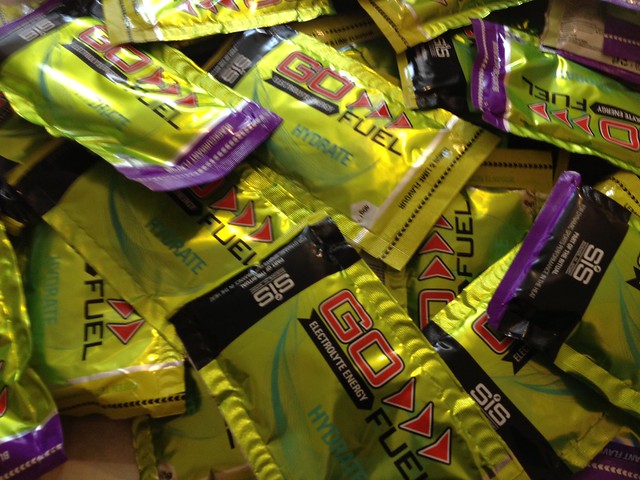
Along with testing out your rucksack before you go, it is important to test out your hydration system too to make sure it works for you.
What hydration system should I take?
You have a number of choices;
Bottles on the front
bottles on the side
Bladders
Side bottles fit to the sides of your rucksack. You will have to buy (if you haven't got) side pockets that fit onto your rucksack. Similarly bottle(s) that you carry on your front fit into a front pack that you will have to fit onto your rucksack.
I don't think I saw anyone with a hydration bladder. They are not that hygienic at the best of times, so add 50 degrees of heat and you could have a recipe for tummy troubles. Bottles are also easier to fill up at the checkpoints and easier to monitor how much you are drinking. Plus you can carry one with electrolytes in, and one just plain water.
I went with Raidlight bottles in side pockets, but I wouldn't recommend them. The long straw got clogged up with sand and wouldn't open, so resulted in me just taking the straw off and using it a a normal bottle. I've had a quick look to see what else is out there, and I can't find any new bottle products with long straws (so you don't have to keep removing your bottle from your side pocket). However the new WAA MDS bag complete with side bottles has now been launched and Laurence Klein (3x female winner) endorses it so could be worth a punt.
However I did prefer carrying bottles at the side rather than in the front though. It takes a bit of time to get used to running with then there. I felt a bit like a robot with zapper guns at my side!
Suggestions welcome as to other thoughts and ideas.
How much should I drink?
I drank around 150ml every 15-20 minutes, and usually alternated between my electrolyte and plain water bottle. This worked well for me. The best plan is to drink little and often as I'm sure you already know.
What else should I drink apart from water?
Electrolytes are vital in Marathon des Sables because they replace the minerals and salts lost in sweating that water cannot. It's important to decide what electrolytes you plan to use and use them before you go, as you need to get used to them. I trialled Nuun, elete, Zero and Go and ended up using elete as they were very light and didn't taste of anything, so I could stomach them better than fruit-based ones.
I used one side bottle for electrolytes and one for plain water.
Likeys stock a great range of electrolytes.
As well as electrolytes you are given a bag of salt tablets for the week. It's important to pop these like sweets as well throughout the day. One of the main reasons people don't complete MDS is not down to a lack of fitness, it's dehydration. And what a crap thing to happen to you after all those months or years of training and planning.
I also drank a recovery shake within 30 minutes of finishing a stage. These were also a nice treat to look forward to as they tasted like milkshake which was heaven out there.
How do you get your water supply?
You get given 1.5 litres at every checkpoint (roughly) and each checkpoint is around 10km. Sometimes you will be given double rations if it is a particularly hot day or strenuous section. You present your punch card at each checkpoint. It gets punched and a smiley MDS volunteer will give you your supply of water.
You also get rations back at camp to be used for washing and cooking as well as drinking.
I had plenty of water for the week. Too much sometimes.
A good tip is to mark your water somehow when you are back in camp. There will be tons of bottles sitting around so it's useful to know which is yours to lessen any problems with upset stomachs from drinking someone else's water.
Friday, 1 February 2013
Marathon des Sables training: speed work
I didn't do any.....
Do you need to do any speed training for Marathon des Sables? Good question. I would hesitantly say no, if your aim is to "just" get round. If you want a top 200 place then you probably need to incorporate some speed work into your training sessions.
But what on earth does speed training mean in the context of something like the Marathon des Sables? You can't tackle it like you would a 10km or even a marathon where the aim may be to get a pb.
I'm open to suggestions on this one, but here's what a bit of research told me:
It helps improve your running economy
This means how much oxygen you use during exercise. If you are economical, you will need less oxygen. Speed work helps improve your running economy.
It increases your maximal aerobic capacity (VO2 max)
Your VO2 max is the maximum amount of oxygen your body can use during exercise. So the higher yours is, the faster you can go without your body feeling stressed.
It helps you use lactate more effectively
Lactate is part of lactate acid. With speed training, it can be used as energy rather than converting to lactate acid.
It helps increase your flexibility
Done jointly with stretching exercises, speed work can help improve your flexibility as it works your muscles and joints through a greater range of motion.
So ultimately, speed work helps ultra runners run faster and more efficiently for longer. It helps improve your cardiovascular efficiency, muscle strength, flexibility and biomechanics. It also helps break up ultra training, which, lets be honest, can get dull plodding out those endless miles week after week.
How to include speed work into your ultra training?
Plan a speed workout the day before a long run. Your legs will be fatigued already, so training on already-tired legs will help you maintain form during multiday ultras where you will be doing this during the race.
Speed sessions should be centred on quality shorter runs (up to 10 miles), nothing longer. Start with fartlek workouts.
Then introduce speed drills e.g. 10s sprint up a hill. Rest 30s. Repeat 10 times.
High intensity training sessions are also recommended.
Do you need to do any speed training for Marathon des Sables? Good question. I would hesitantly say no, if your aim is to "just" get round. If you want a top 200 place then you probably need to incorporate some speed work into your training sessions.
But what on earth does speed training mean in the context of something like the Marathon des Sables? You can't tackle it like you would a 10km or even a marathon where the aim may be to get a pb.
I'm open to suggestions on this one, but here's what a bit of research told me:
It helps improve your running economy
This means how much oxygen you use during exercise. If you are economical, you will need less oxygen. Speed work helps improve your running economy.
It increases your maximal aerobic capacity (VO2 max)
Your VO2 max is the maximum amount of oxygen your body can use during exercise. So the higher yours is, the faster you can go without your body feeling stressed.
It helps you use lactate more effectively
Lactate is part of lactate acid. With speed training, it can be used as energy rather than converting to lactate acid.
It helps increase your flexibility
Done jointly with stretching exercises, speed work can help improve your flexibility as it works your muscles and joints through a greater range of motion.
So ultimately, speed work helps ultra runners run faster and more efficiently for longer. It helps improve your cardiovascular efficiency, muscle strength, flexibility and biomechanics. It also helps break up ultra training, which, lets be honest, can get dull plodding out those endless miles week after week.
How to include speed work into your ultra training?
Plan a speed workout the day before a long run. Your legs will be fatigued already, so training on already-tired legs will help you maintain form during multiday ultras where you will be doing this during the race.
Speed sessions should be centred on quality shorter runs (up to 10 miles), nothing longer. Start with fartlek workouts.
Then introduce speed drills e.g. 10s sprint up a hill. Rest 30s. Repeat 10 times.
High intensity training sessions are also recommended.
Sunday, 27 January 2013
Marathon des Sables training: core work for runners
We all know we should do core exercises to complement cardiovascular work in our training, but there are a few key exercises that are particularly beneficial to runners.
A strong core helps provide power, stability and endurance. Ultra running in particular needs a strong middle to help us go further for longer. Why? A strong core helps to maintain both a good and efficient posture, stride and form meaning less risk of injury or decreased performance.
Core work should include the deep abdominals, back muscles and glutes. I found this brilliant diagrammatic article that shows you how and when the core muscles come into action when you run. Particularly of note to Marathon des Sablers are the uphill (glutes and lower abs needed to support the pelvis to get uphill), endurance (lower abs and back needed to maintain proper form even when fatigued).
I tried to fit in 15 minutes 3x times a week. Easier said than done, even just 15 minutes, as they are painful to do! I found it helped to do the set routine in the gym but friends say they prefer to tag it onto the end of a run instead. These are the exercises I did.
Plank - lie on your stomach and raise yourself up onto your toes and forearms. Keep your body as straight as possible. Hold for 1 minute.
Make it harder?
Raise your left leg up a few inches in the air and hold for 10 seconds. Lower and swap legs.
60 seconds on each. Rest for 15 seconds before moving to the next exercise. After completing all six, take a 3- to 5-minute break, and repeat the entire series. Try to do this routine three times a week.
Side plank - as the plank but lie on one side and lift up onto your foreams and toes, keeping your body in a straight line. Hold for 1 minute. Repeat on the other side.
Make it harder? Bring your bottom knee in towards your chest and hold for five seconds. Repeat with the top knee.
Superman - lie on your front with your arms stretched out. Raise your head, left arm and right leg up a few inches. Hold for 5 seconds then lower and repeat on the other side.
Make it harder? Go all out as fast as possible for the minute.
Bridge - lie on your back with your feet on the ground. Raise your hips so your body is in a straight line. Stablise yourself before raising your right knee towards your chest. Keep your hips stable. Return to the bridge position and repeat with the other leg.
Metronome - lie face up with your legs to one side and your arms out to the side. Lift your legs up as high as possible and arc them over and down to the other side. Repeat and return back to your original position.
Make it harder? Don't let your legs touch the ground in between sets.
A strong core helps provide power, stability and endurance. Ultra running in particular needs a strong middle to help us go further for longer. Why? A strong core helps to maintain both a good and efficient posture, stride and form meaning less risk of injury or decreased performance.
Core work should include the deep abdominals, back muscles and glutes. I found this brilliant diagrammatic article that shows you how and when the core muscles come into action when you run. Particularly of note to Marathon des Sablers are the uphill (glutes and lower abs needed to support the pelvis to get uphill), endurance (lower abs and back needed to maintain proper form even when fatigued).
I tried to fit in 15 minutes 3x times a week. Easier said than done, even just 15 minutes, as they are painful to do! I found it helped to do the set routine in the gym but friends say they prefer to tag it onto the end of a run instead. These are the exercises I did.
Plank - lie on your stomach and raise yourself up onto your toes and forearms. Keep your body as straight as possible. Hold for 1 minute.
Make it harder?
Raise your left leg up a few inches in the air and hold for 10 seconds. Lower and swap legs.
60 seconds on each. Rest for 15 seconds before moving to the next exercise. After completing all six, take a 3- to 5-minute break, and repeat the entire series. Try to do this routine three times a week.
Side plank - as the plank but lie on one side and lift up onto your foreams and toes, keeping your body in a straight line. Hold for 1 minute. Repeat on the other side.
Make it harder? Bring your bottom knee in towards your chest and hold for five seconds. Repeat with the top knee.
Superman - lie on your front with your arms stretched out. Raise your head, left arm and right leg up a few inches. Hold for 5 seconds then lower and repeat on the other side.
Make it harder? Go all out as fast as possible for the minute.
Bridge - lie on your back with your feet on the ground. Raise your hips so your body is in a straight line. Stablise yourself before raising your right knee towards your chest. Keep your hips stable. Return to the bridge position and repeat with the other leg.
Metronome - lie face up with your legs to one side and your arms out to the side. Lift your legs up as high as possible and arc them over and down to the other side. Repeat and return back to your original position.
Make it harder? Don't let your legs touch the ground in between sets.
Wednesday, 16 January 2013
Marathon des Sables: getting used to your kit
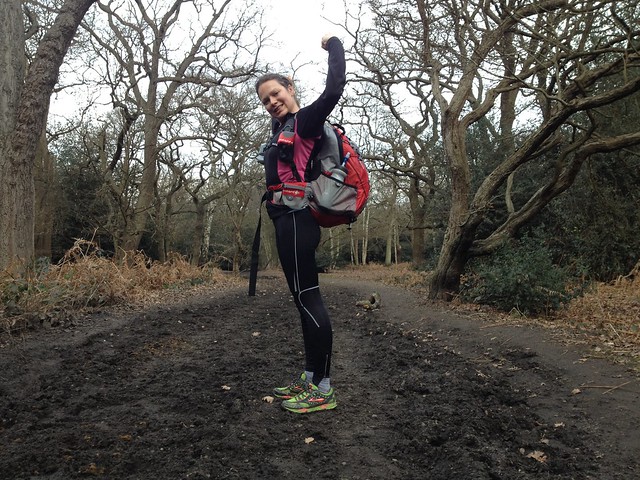
Carrying a 10kg bag is fun!
By now you should be starting to think about what kit you are going to take (if you have not already done so). The smaller items to get matter less at present, but it is important to buy and get used to the bigger pieces. These include:-
Backpack
Frontpack (if taking)
Trainers
Gaiters
Hydration system
Clothes you will wear while shuffling
Backpack
Your backpack will end up weighing between 6.5-15kg once all your kit is in there so it's important to get used to carrying it for long periods of time. However, one good piece of advice I was given was to NOT train with the heavy bag all the time, as it compromises your technique and can increase risk of injury.
I began by running (and walking) in and out of work with a lightish pack, and gradually built up the weight and the length I would carry it for, culminating in 45 miles with around 7kg and a marathon with 10kg. I began carrying a heavy bag from mid February onwards.
Because of this during MDS I had no problems with the bag (other than the obvious - it's a pain to carry and you will get sore shoulders and back. I would rotate between holding it up with my hands behind my back to pulling it forwards to release the pressure from my shoulders every few minutes!)
I also taped my shoulders where the straps sat and the top of my pelvis, where the bag tended to move, and therefore chaff. Other people taped down their spine. Over the tape I put bodyglide to prevent any further chaffing.
Frontpack
Another good reason to get used to your kit is you will also be testing out what works and what doesn't for you. I found that I wanted to add a small frontsack to carry easy-to-get-to items. Other people hated the idea of having extra weight in the front.
Trainers
All runners know you have to give some time before a big race to get used to new trainers, so if you are going to run in a specific trail running shoe, get it soon. I ended up buying 2 different trail trainer and testing them at home inside, then I sent one pair back when I decided which felt more comfortable. I then spent the next couple of months worrying that I had chosen the right pair of trainers!
Buying trainers for MDS is a little different to normal running as you need to take into account that your feet will swell up, so you need a size or so too large. This means normal running will feel a little clumpy and you may need to wear extra socks.
Test your trainers in all conditions - mud, rain, sand, road, stones, up hills, down dunes to see how they feel and grip, and how cushioned they are.
Gaiters
You don't really need to get used to your gaiters, just test them out to check your combination of trainer and gaiter is sandtight. My better half found his choice of trainer was too holey and so sand was getting through, so he switched trainers. Much better to know pre-race.
Hydration system
Along with testing out your backpack for chaffiness and weightiness, is checking that your hydration system works for you. There are two options - bag or bottles. Most people I saw took bottles. Then you have the choice of carrying them in a frontsack or on the sides. I went with sides. Adding water to your rucksack will alter your balance slightly too, so do remember to trial your rucksack with full kit and full water allowance a few times to see what the difference is and how easy you can access your water along the way.
Clothes you will wear when shuffling
Not sure an essential to remember to do, but if you buy new clobber to wear on MDS, test it out a fair few times before you go to check where it may potentially rub. I've not added a post on clothing yet but will write one anyway as talking about clothes is always fun!
Sunday, 13 January 2013
Marathon des Sables: how to prepare for sand
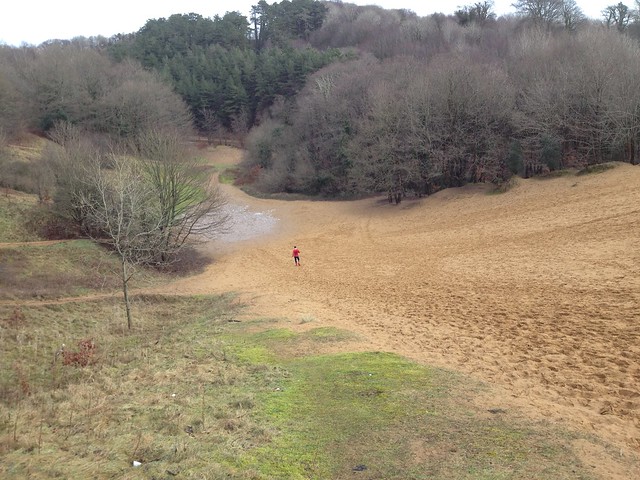
"Big Dipper" - Near Brigend, Wales
Marathon des Sables is not all big sand dunes, but there are a fair few of them. In 2012 stages 1-3 had a lot of dunettes, stage 4 had the major massive dune (be interested if it's in this year) plus dunes in the night, stage 5 was very variable in terms of terrain - sand here and there all throughout, and stage 6 had the major dunes which was tough.
I grew to hate the smaller cutely-named "dunettes" - longer, rolling sets of sandy kilometres. I found more challenging than the big guns because it was difficult to look forwards and see a point to focus on as a goal to reach, like the bigger dunes give you.
However, on the bright side, I don't remember finding the sand as troublesome as I thought I might. Yes it is difficult to run in, but as I walked most of the time, this wasn't an issue! Plus running down dunes is rather good fun.
To get the most out of yourself in a sandy environment you need to concentrate on two things - equipment and technique.
Equipment
You'll need gaiters. Obviously. If you've had your head buried in the sand (ho ho) gaiters are pieces of material (usually parachute silk) that cover your trainers and tie up around your calf to help prevent sand getting into your trainers, and thus lessening the chance of the dreaded blisters accuring.
I used Sandbaggers, which were wonderful. I velcroed them onto my trainers, then also gaffed taped them too.
An important tip to remember is to try out your gaiters before you go, to make sure they are "sandtight".
The other equipment consideration is walking poles. I did not take them, but ended up using a spare pair (unfortunately borrowed from a tent teammate who was pulled out of the race) to help with my ever-painful shin splints.
They were invaluable to me to help cope with the pain, but if I hadn't have suffered from shin splints I would have been fine without them. Having said that, poles do make a lot of difference getting up and down sand (and just anyway really). The toss up is whether you want to carry the extra weight or not.
You still have time to train with them now, but I would advise against getting them any closer to the race as you won't be used to using them.
Last year I would say roughly 15-25% had poles with them.
Technique
I found that you expend less energy and aren't actually much slower if you stick to walking up dunes.
Walking also means you have more time to locate the foot placement of the shuffler in front of you. Treading in the path of others is the best way to get up dunes, as the sand is already more compacted and stable.
I did a weekend in South Wales where the huge sand dunes are. Otherwise, just getting off road onto stony, muddy, hilly ground is great preparation for sand running too.
Wednesday, 9 January 2013
Marathon des Sables: how to prepare for heat
![IMG_0262[1]](http://farm8.staticflickr.com/7113/6947894654_66730497b3_z.jpg)
Scorchio!
52 degrees. That's how high the temperature got last year in the Sahara. To be honest, I couldn't tell the difference between 42 and 52 degrees. It was just bloody hot.
The heat affects people in different ways. It doesn't affect some runners at all, particularly those who are already used to running in hot weather (alas not us Brits!). Others get severe heat exhaustion and end up being pulled out of the race.
I found I just felt vaguely nauseous most of the time. The heat slowed my pace down to a mere snail shuffle at the best of times too. My hands and feet became swollen and my heart hammered in my chest.
The problem with heat
Some runners are concerned with heat in the Marathon des Sables for health reasons, others for performance reasons.
Health wise the main problem with running in the heat is it makes you sweat more than normal to cool you down, and when you sweat you lose vital electrolytes and fluids. If these are not replaced effectively, you will end up dehydrated and in a mess, with muscle cramps, hallucinations, talking rubbish and in worst case scenario, being pulled from the race. This is also known as heat exhaustion.
Heat oedema is also an issue. Blood vessels have to dilate to send fluid to extremities to get rid of the heat in the body. However the heart has trouble getting it back to the centre because of gravity, meaning your fingers and toes swell up. Not usually a problem, except when you are trying to prevent the dreaded blisters!
Performance wise, you run slower in the heat. Why? Your blood volume decreases due to sweating, meaning there is less oxygenated blood to go round the body, meaning less oxygen gets to your muscles - where it's needed. There is also the double whammy of your blood being diverted to the skin to cool down, rather than your muscles, where it would normally flow to in colder climes.
How best to prepare for the heat - before
Sort out a routine for drinking and taking salt tablets. I worked on a basis of 150ml every 15-20 minutes and a salt tablet every 30-40 minutes.
Trial electrolytes before you go and choose ones that you can cope with. I choose neutral ones eventually as sweeter ones just made me feel sick.
Take more electrolytes about 3 days prior to starting.
Be aware you will run MDS slower than in Britain, and remember this when you are out there. Don't let it become a negative thought as there is nothing you can do!
About three weeks before you fly out, start a heat acclimatisation programme. The two best ways to do this in the UK is 1) exercise in a sauna 2) run in lots of clothes.
There is also bikram yoga, but I found this too humid to represent conditions, and I developed blisters from it too. Don't forget two main rules - build up time spend exercising slowly (15 minutes to begin with) and take plenty of water and electrolytes in.
What to do when you are out there
Wear a white hat with neckguard.
Wear shoes that are a size too big to allow your feet to expand.
USE your routine that you have prepared for drinking water and taking salt tablets, but do adapt it if you need to. Having a routine is good a it forces you to remind yourself regularly to drink. It doesn't take long to become dehydrated, and therefore disorientated and confused about what you should be doing when.
Smother yourself in P20 - you don't want to deal with burn skin. P20 is excellent. You only need to apply it once.
Good luck!
Wednesday, 2 January 2013
Marathon des Sables: hill training
![IMG_0246[1]](http://farm8.staticflickr.com/7102/6950502892_aaba16f35a_z.jpg)
The easy bit!
Perhaps not surprisingly, Marathon des Sables has a fair few hills - both of the sand and rocky variety. Some hills are long, slow inclines. Others are brutal sharp, steep inclines.
Last year on day 4 (the long day) the organisers gave us a 2 hour climb up rocks and boulders, before traversing via a rope down the biggest dune I've ever seen.
The big dunes are infamous in MDS, but there are also cutely-named "dunettes" - smaller, rolling dunes that can last for many kilometres.
So hill training has to be a big must in any MDS programme.
Last year, outside, I concentrated on getting up long, sustained hills rather than sprinting up short ones, as that's what MDS is going to test you on.
I devised a good gym session as follows:
5 minute warm up on stepper.
15 minutes on stepper at level 8/9 effort carrying 10kg weight in bag.
15 minutes targeted strength exercises - lunges onto balance ball, one legged squats, side lie glut med lifts.
15 minutes on treadmill. 10% incline. Run 3 minutes at 8.5kmh. Rest 1 minute. Repeat.
10 minute stretching routine.
I also ran a specific hill training session 1x week, but also make sure they were included in most runs too. However, I was a little too haphazard in my approach. I think it would have been better to plan out the hill sessions 1x week so you are slowly increasing the difficulty over time, and making sure you do include specific hill training routines into your running.
I would advise working on:-
Intervals - 250m up to 1 mile. Increase sets slowly up. For 250m, I would work on 5 reps, then increase up to 5x3 sets. For 1 mile, I would work on 2 reps, then increase up to 5 reps.
Medium-long hilly running - plan an run a few routes with considerable hills. If you can get out to somewhere like to Peaks or South Downs, this would be excellent practice. Get out for at least three hours, preferably more. Don't worry about time, just think about getting up and down the hills with good form.
Weight - don't run with your pack on all the time, but do try your hill reps with your heavy pack to get the feel of it. It will shift your balance and posture, so takes some time to adjust. Plus it's much harder with an additional 10kg!
Want more hill talk? See here
Thursday, 20 December 2012
Marathon des Sables training: Strength work
If there's ever a time to invest in specific strength training as a runner, it's when you are preparing for the Marathon des Sables. It's not just cardio work that you need to do.
Why?
You are on your feet for longer so you need strong(er) legs and core to keep you going for that extra distance.
Strength training improves running economy - how efficiently your body uses oxygen. If your body is using oxygen better, it means you can also run faster and for longer too.
It will help keep running injuries at bay, particularly knee and ITB issues - which can become a problem with all that extra mileage you will be doing.
MDS has plenty of hills and dunes to scale up and down and strong legs will help prevent you becoming a sobbing heap of wretchedness at the bottom of the umpteenth one.
Exercises don't have to be complicated or tedious either. I just introduced these easy leg routines into my gym sessions. 20 minutes. Done!
1) Single leg squats.
2) Lunges.
3) Step-ups.
4) Single-legged jumps.
5) The clam and side lying hip abduction.
I started off with 2 sets of 10 and built up to 3 sets of 15. Once I could do this comfortably, I added the harder element to each exercise by either adding weight or resistance from a theraband or freeweight, or doing the exercise onto an uneven surface.
I definitely noticed the difference, and I enjoyed doing the routine, as it was a bit of a welcome break from running all the time!
Don't forget hill training sessions also count as strengthening workouts too. More on that next week.
Why?
You are on your feet for longer so you need strong(er) legs and core to keep you going for that extra distance.
Strength training improves running economy - how efficiently your body uses oxygen. If your body is using oxygen better, it means you can also run faster and for longer too.
It will help keep running injuries at bay, particularly knee and ITB issues - which can become a problem with all that extra mileage you will be doing.
MDS has plenty of hills and dunes to scale up and down and strong legs will help prevent you becoming a sobbing heap of wretchedness at the bottom of the umpteenth one.
Exercises don't have to be complicated or tedious either. I just introduced these easy leg routines into my gym sessions. 20 minutes. Done!
1) Single leg squats.
2) Lunges.
3) Step-ups.
4) Single-legged jumps.
5) The clam and side lying hip abduction.
I started off with 2 sets of 10 and built up to 3 sets of 15. Once I could do this comfortably, I added the harder element to each exercise by either adding weight or resistance from a theraband or freeweight, or doing the exercise onto an uneven surface.
I definitely noticed the difference, and I enjoyed doing the routine, as it was a bit of a welcome break from running all the time!
Don't forget hill training sessions also count as strengthening workouts too. More on that next week.
Friday, 14 December 2012
Marathon des Sables training: Mileage - how much, how far, how fast?
How many miles a week you should be running pre MDS is the big question everyone asks.
A google round other people's past MDS blogs shows huge variation. Some are extremely laid back about the whole process and do just that bit extra to their normal regime. Others go hell for leather mounting up multiple 12+ hour days out, fully kitted and booted up.
In my humble opinion I think less is slightly more. Marathon des Sables tests two main things out on you:
1) Being able to run (i.e shuffle) day after day with no rest
2) Being able to run long distances, by this I mean between 20-50 miles
With that in mind I slowly built in elements of these key things into my running foundation.
I built up back to back runs, from daily jogs to and from work, to 15 miles x3, to 25 miles x3. By January I was doing 15 miles back to back okay. There are many multiday races out there pre MDS to help you do this if you want it to be a bit more enjoyable.
I built up my distance. You need to be able to run a marathon fairly comfortably now and if you haven't attempted an ultra, you should aim to get one in at least. In my training I managed 2x 30 miles 1x 38 miles and 1x 45 mile race. By January I had done all this.
Running long miles takes it out of your body, and it took me far longer than I thought it would to recover from each race. In hindsight I would have liked to have done one more ultra race, just to give me the confidence more than anything, as they are pretty painful!
My weekly mileage tally shows I averaged around 40 miles a week after Christmas - not many miles really. Should I have done more? Yes I probably could have done with fitting in more solid back to back runs with a long run each weekend, but I managed to get round ok in the end. It was the shin splints rather than fitness which ended up as my problem out there. But that's the key - it's more about what type of running you are doing rather than endlessly tallying up the weekly mileage. Quality, not quantity. Your training should be specific to what the MDS is going to test you in.
Finally, pace! Well I ran at an average of 12 minute mile pace for my training runs. MDS will challenge your body like nothing else. It's the heat that means you can't run as you'd like to. If you are going out there with the aim of enjoying it and finishing it, stick with the snail pace as your body will become used to it during training (even 12 min mile pace is pushing it, much of MDS is unfortunately spent walking). If you are going for a top 250 place, you should probably find someone else's blog to read!
Seriously, if you are concerned with placing I would advise you to learn how to keep a steady pace and maintain it, bear in mind that 12 min mile pace is pretty rapid out there, learn how to run in sand and up hills, learn how to look after your feet and keep your pack lighter than 7kg. You can make up heaps of time as well by getting yourself to the start of day 4 feeling in a good way with your feet in good nick and getting it done with no sleep, as many competitors decide to sleep for a few hours before setting off again or are completely broken by this point so are ridiculously slow!
If I've got my maths right the winners run at 8 min mile pace and the slowest run at
22 min mile pace which gives you an idea of realistic pace.
A google round other people's past MDS blogs shows huge variation. Some are extremely laid back about the whole process and do just that bit extra to their normal regime. Others go hell for leather mounting up multiple 12+ hour days out, fully kitted and booted up.
In my humble opinion I think less is slightly more. Marathon des Sables tests two main things out on you:
1) Being able to run (i.e shuffle) day after day with no rest
2) Being able to run long distances, by this I mean between 20-50 miles
With that in mind I slowly built in elements of these key things into my running foundation.
I built up back to back runs, from daily jogs to and from work, to 15 miles x3, to 25 miles x3. By January I was doing 15 miles back to back okay. There are many multiday races out there pre MDS to help you do this if you want it to be a bit more enjoyable.
I built up my distance. You need to be able to run a marathon fairly comfortably now and if you haven't attempted an ultra, you should aim to get one in at least. In my training I managed 2x 30 miles 1x 38 miles and 1x 45 mile race. By January I had done all this.
Running long miles takes it out of your body, and it took me far longer than I thought it would to recover from each race. In hindsight I would have liked to have done one more ultra race, just to give me the confidence more than anything, as they are pretty painful!
My weekly mileage tally shows I averaged around 40 miles a week after Christmas - not many miles really. Should I have done more? Yes I probably could have done with fitting in more solid back to back runs with a long run each weekend, but I managed to get round ok in the end. It was the shin splints rather than fitness which ended up as my problem out there. But that's the key - it's more about what type of running you are doing rather than endlessly tallying up the weekly mileage. Quality, not quantity. Your training should be specific to what the MDS is going to test you in.
Finally, pace! Well I ran at an average of 12 minute mile pace for my training runs. MDS will challenge your body like nothing else. It's the heat that means you can't run as you'd like to. If you are going out there with the aim of enjoying it and finishing it, stick with the snail pace as your body will become used to it during training (even 12 min mile pace is pushing it, much of MDS is unfortunately spent walking). If you are going for a top 250 place, you should probably find someone else's blog to read!
Seriously, if you are concerned with placing I would advise you to learn how to keep a steady pace and maintain it, bear in mind that 12 min mile pace is pretty rapid out there, learn how to run in sand and up hills, learn how to look after your feet and keep your pack lighter than 7kg. You can make up heaps of time as well by getting yourself to the start of day 4 feeling in a good way with your feet in good nick and getting it done with no sleep, as many competitors decide to sleep for a few hours before setting off again or are completely broken by this point so are ridiculously slow!
If I've got my maths right the winners run at 8 min mile pace and the slowest run at
22 min mile pace which gives you an idea of realistic pace.
Wednesday, 12 December 2012
Marathon des Sables countdown: the hard training months
![IMG_0276[1]](http://farm8.staticflickr.com/7232/6947911436_1a97bb377d.jpg)
The end is just over that next dune...or perhaps it's the next one...no really, it must be the next one
While I kick back in my armchair laden with pipe and slippers, all you Marathon des Sablers out there will be shuffling away mile and mile, hill after hill, into the depths of the heavy training period.
You lucky people.
I still get asked various questions about MDS so over the next few weeks I'm going to write a few handy hints posts to help you through those heavy miles. I'm no expert so I don't have all the answers but I hopefully will help ease any worries you may have, having shuffled round in 2012.
My posts will be as follows:
Week 1: Mileage - how much, how far, how fast?
Week 2: Strength work
Week 3: Hill training
Week 4: Heat and sand - how to prepare
Week 5: Key equipment
Week 6: Getting used to your MDS kit
Week 7: Core work
Week 8: Speed work
Week 9: Hydration
Week 10: Nutrition
Week 11: Footcare
Week 12: Mental preparation
Week 13: What to expect the week before
Week 14: Camp life
Week 15: Recovery and good luck!
I'd love to hear your experiences so far of training and what you hope to get out of the race.
Remember, you have probably done far more than what you think you have already. If you are sensible and believe in yourself you will finish the race.
The 16 week countdown begins. Good luck!
Thursday, 17 May 2012
MDS training advice
NEW! What worked and what didn't: the training rules for Marathon des Sables
Updated and revised training plan for the marathon des sables!
I now have less than 12 weeks to go and am learning a lot about the what training works for multiday ultra races such as the marathon des sables.
1) Don't forget the shorter, faster runs
Running long wears your body out (well it does mine). Training needs to be about QUALITY not QUANTITY, so I'm now focusing a little more on shorter, quality sessions.
Speed training also ensures you feel fresh and keep your motivation. It may also help ensure you beat the camel!
My shorter runs range from 3-10 miles, and are done without a backpack to make sure my technique is as good as possible and I can run as fast as possible! I've been mostly doing this on a treadmill, but will try to build in a lunchtime run outdoors without a rucksack to get some variation.
2) Hills, hills, hills
Urgh! Hate 'em but MDS has A LOT of dunes to conquer so they are a necessary evil. Plus you get killer pins from them, and they wear you out like nothing else and make you feel damn good for the rest of the day.
Again, varied between the gym and the great outdoors, and also between length of hill and speed run at.
London has some excellent hill training choices:-
Primrose Hill - probably the worst of the lot, fairly long and steep, but you are rewarded with great views.
Parliament Hill - similar to Primrose Hill for view rewards, but can be done over a longer, slightly less steep incline.
Ally Pally/Muswell Hill - short, sharp and painful sessions can be done here.
Queens Woods - one of my favourite places for hills. Very, very pretty and off road terrain too.
Richmond Park - there a couple of longer, punishing hills here and a rather nasty short incline.
Plenty more places I am sure.
I'm also venturing outside of London to, again keep the motivation up, to Boxhill - home of the cyclist really, but notorious for it's long, long inclines.
3) Sand, sand, sand
There's a definite technique to running in sand. I've tried it once and managed a mile, so slightly concerned about 150 miles, but hey.
The biggest sand dune "The Big Dipper" in Europe can be found near Bridgend, South Wales apparently, so I'm off there for a long weekend of running up and down, up and down, up and down etc etc etc.
For a change I'll be trekking over to my parent's home on the Suffolk coast for more sand running. And if you can avoid the dog crap, Hyde Park's rotten row is also a poor man's sand choice.
I'll also be doing The Running Man in my neighbour's sandpit (kidding).
4) Targeted strength training
5) Core work
6) Flexibility and stretching
Otherwise I've amended the below - some is still very relevant - other parts I've not achieved, or I now realise it's not that good a plan!
Original training plan for the marathon des sables - September 2010
Surprisingly there isn't much out there on how to train for an ultra. There's plenty of advice on running marathons and also 50-100 miles races, but not back to back multiday events like the marathon des sables.
So here are some initial beer and wine inspired thoughts on what should come in a multi-day ultra training plan ...
Thinking came around what new challenges there will be, some milestones for how to prepare for them, and how that preparation fits in over the next 6 months:
1) Running with a heavy bag: Do lots of running to and from work with a progressively heavier bag throughout the next 6 months.
Updated - I now think this should be fairly targeted. Do some runs with a heavy bag but not all. Good technique is more important.
2) 50 mile run: Get one of these in in after Christmas - take it very steady with lots of stops.
Updated - yes. I've got one 45 miler under my belt now. Still working out whether to do one more at the beginning of February. Watch this space..
3) Back-to-back long runs: Structure some cumulative long mile weekends - e.g. Build up to doing this one week in mid Feb: Thursday 10 miles (to work/back), Friday 15 miles (to work/back plus extension), Sat 30 miles, Sun 20, Mon 10 (to work and back). In addition, doing back to back weekend runs of (say) 20 miles Sat, 10 miles sun.
Updated - yes. I'm now focusing on 10-20 mile back to backs to make sure I have the day after day endurance built up.
4) High weekly mileage: I reckon the most I've ever done is 50 in a week, and 150 in training ain't gonna happen, but will target getting up to 75 miles per week average over a month.
Updated - I'm only up to around 40 a week at present, though this will increase over the next two months. I still feel it's important to get many miles under your belt, but it should be more varied, with greater hill and speed sessions as well.
5) Heat: Instinct tells me that you can only really heat acclimatise a fairly short time before. Lots of saunas! (And maybe press-ups etc. In the sauna), Bikram yoga, running in lots of very hot clothes (looking like michelin man).
Updated - yes. I'm booking into Bikram yoga 10 days before we go, and will be mostly found sat in a sauna.
6) Sand/blisters: Am open to suggestion, but best I've read on this is to toughen up feet by running without socks for a month, and then start putting a bit of sand in your shoes for runs! Shoe and sock choice will be key. As well as generally getting plenty of miles in.
Updated - Fixing your Feet website is excellent. I'm trialing surgical spirit now. I haven't braved running without socks or with sand, and I'm not sure I will either. I'm hoping to rely on good trainers, gaitors, socks and foot hygiene and taping knowledge.
7) Long days outdoors: It sounds daft, but it's actually quite tiring just been out on your feet and exposed to the elements for long periods. Supplement long training runs with days/weekends out walking in hills etc as time permits.
Updated - yes, definitely. Helps save the joints too, and is fun.
8) Food/nutrition: Research and test what to eat. I'm looking into protein powder recovery drinks as apparently a good idea. Expedition Foods seem good. Nuts and raisins must be good too. Chocolate and chips possibly not. Though would like.
Updated - yes. See my post on foods for marathon des sables.
9) Sand dunes and rough terrain: Do as much of the training on hills and off-road as possible. Hill reps.
Updated - yes, definitely.
10) Kit: research and test all the kit we'll need.
Updated - yup. This is another key area so I've dedicated a page to kit and equipment for the marathon des sables
Updated and revised training plan for the marathon des sables!
I now have less than 12 weeks to go and am learning a lot about the what training works for multiday ultra races such as the marathon des sables.
1) Don't forget the shorter, faster runs
Running long wears your body out (well it does mine). Training needs to be about QUALITY not QUANTITY, so I'm now focusing a little more on shorter, quality sessions.
Speed training also ensures you feel fresh and keep your motivation. It may also help ensure you beat the camel!
My shorter runs range from 3-10 miles, and are done without a backpack to make sure my technique is as good as possible and I can run as fast as possible! I've been mostly doing this on a treadmill, but will try to build in a lunchtime run outdoors without a rucksack to get some variation.
2) Hills, hills, hills
Urgh! Hate 'em but MDS has A LOT of dunes to conquer so they are a necessary evil. Plus you get killer pins from them, and they wear you out like nothing else and make you feel damn good for the rest of the day.
Again, varied between the gym and the great outdoors, and also between length of hill and speed run at.
London has some excellent hill training choices:-
Primrose Hill - probably the worst of the lot, fairly long and steep, but you are rewarded with great views.
Parliament Hill - similar to Primrose Hill for view rewards, but can be done over a longer, slightly less steep incline.
Ally Pally/Muswell Hill - short, sharp and painful sessions can be done here.
Queens Woods - one of my favourite places for hills. Very, very pretty and off road terrain too.
Richmond Park - there a couple of longer, punishing hills here and a rather nasty short incline.
Plenty more places I am sure.
I'm also venturing outside of London to, again keep the motivation up, to Boxhill - home of the cyclist really, but notorious for it's long, long inclines.
3) Sand, sand, sand
There's a definite technique to running in sand. I've tried it once and managed a mile, so slightly concerned about 150 miles, but hey.
The biggest sand dune "The Big Dipper" in Europe can be found near Bridgend, South Wales apparently, so I'm off there for a long weekend of running up and down, up and down, up and down etc etc etc.
For a change I'll be trekking over to my parent's home on the Suffolk coast for more sand running. And if you can avoid the dog crap, Hyde Park's rotten row is also a poor man's sand choice.
I'll also be doing The Running Man in my neighbour's sandpit (kidding).
4) Targeted strength training
5) Core work
6) Flexibility and stretching
Otherwise I've amended the below - some is still very relevant - other parts I've not achieved, or I now realise it's not that good a plan!
Original training plan for the marathon des sables - September 2010
Surprisingly there isn't much out there on how to train for an ultra. There's plenty of advice on running marathons and also 50-100 miles races, but not back to back multiday events like the marathon des sables.
So here are some initial beer and wine inspired thoughts on what should come in a multi-day ultra training plan ...
Thinking came around what new challenges there will be, some milestones for how to prepare for them, and how that preparation fits in over the next 6 months:
1) Running with a heavy bag: Do lots of running to and from work with a progressively heavier bag throughout the next 6 months.
Updated - I now think this should be fairly targeted. Do some runs with a heavy bag but not all. Good technique is more important.
2) 50 mile run: Get one of these in in after Christmas - take it very steady with lots of stops.
Updated - yes. I've got one 45 miler under my belt now. Still working out whether to do one more at the beginning of February. Watch this space..
3) Back-to-back long runs: Structure some cumulative long mile weekends - e.g. Build up to doing this one week in mid Feb: Thursday 10 miles (to work/back), Friday 15 miles (to work/back plus extension), Sat 30 miles, Sun 20, Mon 10 (to work and back). In addition, doing back to back weekend runs of (say) 20 miles Sat, 10 miles sun.
Updated - yes. I'm now focusing on 10-20 mile back to backs to make sure I have the day after day endurance built up.
4) High weekly mileage: I reckon the most I've ever done is 50 in a week, and 150 in training ain't gonna happen, but will target getting up to 75 miles per week average over a month.
Updated - I'm only up to around 40 a week at present, though this will increase over the next two months. I still feel it's important to get many miles under your belt, but it should be more varied, with greater hill and speed sessions as well.
5) Heat: Instinct tells me that you can only really heat acclimatise a fairly short time before. Lots of saunas! (And maybe press-ups etc. In the sauna), Bikram yoga, running in lots of very hot clothes (looking like michelin man).
Updated - yes. I'm booking into Bikram yoga 10 days before we go, and will be mostly found sat in a sauna.
6) Sand/blisters: Am open to suggestion, but best I've read on this is to toughen up feet by running without socks for a month, and then start putting a bit of sand in your shoes for runs! Shoe and sock choice will be key. As well as generally getting plenty of miles in.
Updated - Fixing your Feet website is excellent. I'm trialing surgical spirit now. I haven't braved running without socks or with sand, and I'm not sure I will either. I'm hoping to rely on good trainers, gaitors, socks and foot hygiene and taping knowledge.
7) Long days outdoors: It sounds daft, but it's actually quite tiring just been out on your feet and exposed to the elements for long periods. Supplement long training runs with days/weekends out walking in hills etc as time permits.
Updated - yes, definitely. Helps save the joints too, and is fun.
8) Food/nutrition: Research and test what to eat. I'm looking into protein powder recovery drinks as apparently a good idea. Expedition Foods seem good. Nuts and raisins must be good too. Chocolate and chips possibly not. Though would like.
Updated - yes. See my post on foods for marathon des sables.
9) Sand dunes and rough terrain: Do as much of the training on hills and off-road as possible. Hill reps.
Updated - yes, definitely.
10) Kit: research and test all the kit we'll need.
Updated - yup. This is another key area so I've dedicated a page to kit and equipment for the marathon des sables
Monday, 14 May 2012
My weekly mileage for MDS
Week 1 22.5
Week 2 23.5
Week 3 37.5
Week 4 19
Week 5 35.5
Week 6 29
Week 7 41.5
Week 8 54
Week 9 23
Week 10 39
Week 11 1 - eek
Week 12 0 - argh
Week 13 40 - phew
Week 14 49.5
Week 15 - 35
Week 16 - 63
Week 17 - 45.5 (plus hardcore dunes)
Week 18 - 35 (dodgy hip and snow)
Week 19 - 35 (hip still dodgy - falling apart, need zimmer)
Week 20 - 40 (hip less dodgy but still dodgy plus knee and calf hanging on by thread)
Week 21 - 86 WOOHOO
Week 22 - 15
Week 23 - 28
Week 24 - 26.2
Week 25 - 5
Week 2 23.5
Week 3 37.5
Week 4 19
Week 5 35.5
Week 6 29
Week 7 41.5
Week 8 54
Week 9 23
Week 10 39
Week 11 1 - eek
Week 12 0 - argh
Week 13 40 - phew
Week 14 49.5
Week 15 - 35
Week 16 - 63
Week 17 - 45.5 (plus hardcore dunes)
Week 18 - 35 (dodgy hip and snow)
Week 19 - 35 (hip still dodgy - falling apart, need zimmer)
Week 20 - 40 (hip less dodgy but still dodgy plus knee and calf hanging on by thread)
Week 21 - 86 WOOHOO
Week 22 - 15
Week 23 - 28
Week 24 - 26.2
Week 25 - 5
Tuesday, 1 May 2012
Training for the Marathon des Sables: what worked and what didn't
If I were to advise one thing for those planning their training for Marathon des Sables, I would say get used to long days out hiking/running with a heavy bag.
Do this and you will be fine. If you can do this in a hot country, you may even be a contender for a good place.
Otherwise this is what my training looked like and how useful I found the strategy to be:-
Running with a heavy bag
I think it's important to get used to this, but don't do all your running with a bag. You'll lose your technique (and your love of running, trust me).
I had virtually no issues with sore back or shoulders. I had no chafing problems either. Some people had horrendous sores on their back.
See also what equipment I took. My bag weighed 9kg. Get down to this or less if you can, particularly of you want a place.
If you are serious about a top 200 place your bag must be in the 6.5 to 7kg range.
50 mile run
I managed one 45 mile race, the Country to Capital. I wanted to fit in two but in the end felt I wouldn't have enough time to recover (I only trained for 6 months prior to the race).
The race helped me but more in a mental way. It was hard! but I knew I could do it.
I would aim to get in two long races if possible. Maybe aim for one fast time, and one with hills and a pack.
Back-to-back long runs
Essential. You need to get used to running long miles day after day after day. I built up from running into work everyday (4.5 miles) to three back to back 25 milers.
I think these were important as they help you get used to the right pace. Go too fast and your muscles will be ruined to do a good job the next day.
Heat
Unless you can get out to a hot country and train, this will be a problem. I thought I'd be ok as I love the sun, but 50 degrees is 50 degrees.
I spent two weeks prior to leaving doing sweaty yoga, stretching in the sauna, having hot baths and exercising in my flat with the heating up full whack!
I still suffered from sausage finger syndrome and felt fairly nauseous out there.
If you've got the time (and money) invest in some heat chamber sessions as well as doing all of the above. I would also try and get out to the desert a week beforehand and acclimatise.
Sand
This didn't really trouble me too much. Many sections are hard and rocky which is something to bear in mind. Training down in Mertyr Mawr did prepare me for the dunes though and I would recommend this, even if it is just to test your trainers and gaiters don't let in any sand.
Long days outdoors
In hindsight I would have added in more weekends away out hiking outdoors in hilly locations. This is great preparation for the Marathon des Sables. It also gives you a chance to have a break from running, and gives the joints a bit of a rest.
Hills
I managed to get in a fair few hill training sessions - some short, fast, others long, slow. I tried to do 1x specific session a week, and at least 1x run that included hills. However on reflection, I don't think I did enough slower, long sessions with a bag.
Now I've completed the Marathon des Sables, I would say hill training is essential, essential, essential. There aren't hills everywhere, but there are a fair few - and they are big. There are also all the dunes, and the slow, steady inclines to factor in.
Some hills you will have to walk up. Others you can shuffle up. I found I did overtake people up hills as my legs felt strong.
Targeted strength training
Your legs have to be strong. Especially your hip abductors - your key stability muscles for walking, and also supporting your bag.
I made sure I included at least 2x week targeted strength work. I would recommend this for all runners though. I've never done this before - I just ran - and I noticed the difference. I would start this as early as possible as it takes a while to get the right technique, and build up the strength.
Strength work also helps you identify potential weak areas, which helps prevent injury too.
Core work/Flexibility and stretching
More of a generic one for all runners again, but I tried to fit in 3x week core work, with 1x week yoga or pilates session. I found my joints became very stiff with the increase in training, so the pilates and yoga really helped this. I was also religious about stretching after a run.
High weekly mileage
I ended up only racking up an average of 40 miles a week (see right for my tally) whereas I thought I'd do more. In hindsight I think this was okay. I've read blogs of people who do less than this and finish. Again I guess if you want a good place you should do more miles.
I struggled a bit with knowing when to taper. In the end I went for 3 weeks before (though I did run a marathon in my taper. Ha!).
I think a lot of people underestimate the effort your body goes through (unless you normally train in this way and this number of miles).
I felt really good at the start. My muscles and joints were relaxed. I had spent the last two weeks doing a lot of yoga and stretching which was also beneficial.
Short, fast runs without a backpack/speed sessions
These ranged between 3-10 miles. They are not necessarily specific training to the Marathon des Sables, and I wouldn't concentrate too much on them, but they do help add miles to your weekly total, and break up the monotony of the super long days out!
If you are going for a place then these will definitely be more important to you. I'completely lost my speed. 12 minute mile pace (as opposed to 8) is my comfort zone at the moment, but I can jog at this pace for a long time!
Do this and you will be fine. If you can do this in a hot country, you may even be a contender for a good place.
Otherwise this is what my training looked like and how useful I found the strategy to be:-
Running with a heavy bag
I think it's important to get used to this, but don't do all your running with a bag. You'll lose your technique (and your love of running, trust me).
I had virtually no issues with sore back or shoulders. I had no chafing problems either. Some people had horrendous sores on their back.
See also what equipment I took. My bag weighed 9kg. Get down to this or less if you can, particularly of you want a place.
If you are serious about a top 200 place your bag must be in the 6.5 to 7kg range.
50 mile run
I managed one 45 mile race, the Country to Capital. I wanted to fit in two but in the end felt I wouldn't have enough time to recover (I only trained for 6 months prior to the race).
The race helped me but more in a mental way. It was hard! but I knew I could do it.
I would aim to get in two long races if possible. Maybe aim for one fast time, and one with hills and a pack.
Back-to-back long runs
Essential. You need to get used to running long miles day after day after day. I built up from running into work everyday (4.5 miles) to three back to back 25 milers.
I think these were important as they help you get used to the right pace. Go too fast and your muscles will be ruined to do a good job the next day.
Heat
Unless you can get out to a hot country and train, this will be a problem. I thought I'd be ok as I love the sun, but 50 degrees is 50 degrees.
I spent two weeks prior to leaving doing sweaty yoga, stretching in the sauna, having hot baths and exercising in my flat with the heating up full whack!
I still suffered from sausage finger syndrome and felt fairly nauseous out there.
If you've got the time (and money) invest in some heat chamber sessions as well as doing all of the above. I would also try and get out to the desert a week beforehand and acclimatise.
Sand
This didn't really trouble me too much. Many sections are hard and rocky which is something to bear in mind. Training down in Mertyr Mawr did prepare me for the dunes though and I would recommend this, even if it is just to test your trainers and gaiters don't let in any sand.
Long days outdoors
In hindsight I would have added in more weekends away out hiking outdoors in hilly locations. This is great preparation for the Marathon des Sables. It also gives you a chance to have a break from running, and gives the joints a bit of a rest.
Hills
I managed to get in a fair few hill training sessions - some short, fast, others long, slow. I tried to do 1x specific session a week, and at least 1x run that included hills. However on reflection, I don't think I did enough slower, long sessions with a bag.
Now I've completed the Marathon des Sables, I would say hill training is essential, essential, essential. There aren't hills everywhere, but there are a fair few - and they are big. There are also all the dunes, and the slow, steady inclines to factor in.
Some hills you will have to walk up. Others you can shuffle up. I found I did overtake people up hills as my legs felt strong.
Targeted strength training
Your legs have to be strong. Especially your hip abductors - your key stability muscles for walking, and also supporting your bag.
I made sure I included at least 2x week targeted strength work. I would recommend this for all runners though. I've never done this before - I just ran - and I noticed the difference. I would start this as early as possible as it takes a while to get the right technique, and build up the strength.
Strength work also helps you identify potential weak areas, which helps prevent injury too.
Core work/Flexibility and stretching
More of a generic one for all runners again, but I tried to fit in 3x week core work, with 1x week yoga or pilates session. I found my joints became very stiff with the increase in training, so the pilates and yoga really helped this. I was also religious about stretching after a run.
High weekly mileage
I ended up only racking up an average of 40 miles a week (see right for my tally) whereas I thought I'd do more. In hindsight I think this was okay. I've read blogs of people who do less than this and finish. Again I guess if you want a good place you should do more miles.
I struggled a bit with knowing when to taper. In the end I went for 3 weeks before (though I did run a marathon in my taper. Ha!).
I think a lot of people underestimate the effort your body goes through (unless you normally train in this way and this number of miles).
I felt really good at the start. My muscles and joints were relaxed. I had spent the last two weeks doing a lot of yoga and stretching which was also beneficial.
Short, fast runs without a backpack/speed sessions
These ranged between 3-10 miles. They are not necessarily specific training to the Marathon des Sables, and I wouldn't concentrate too much on them, but they do help add miles to your weekly total, and break up the monotony of the super long days out!
If you are going for a place then these will definitely be more important to you. I'completely lost my speed. 12 minute mile pace (as opposed to 8) is my comfort zone at the moment, but I can jog at this pace for a long time!
Friday, 30 March 2012
The final countdown: Endurance Life marathon
![IMG_0207[1]](http://farm7.staticflickr.com/6227/7029717755_a4c37e5cbe_z.jpg)
The final box to tick in terms of training for the Marathon des Sables was to run a hard, hilly, hot marathon with the full 10kg bag. This ended up being the Endurance Life marathon held around Seven Sisters and Beachy Head (no I didn’t have any second thoughts…), in Eastbourne.
Bizarrely I wasn’t nervous at all which is quite unusual for me. I think this was because I knew it was a training run, and I was also very aware that this would be a walk in the park compared to the looming race ahead.
It also was a bit of a treat – I was getting out of London to a beautiful part of England, the sun was shining and I had plenty of food supplies on my back to keep me going :-)
The race started as it meant to go along. Hills. I tried running up them all but gave up.
Not really. I reckon if I was just doing this as my big race I would have given it my all. I very much doubt I could have run up all of them – around Seven Sisters was a killer – but my strategy for the race was to finish it feeling good and confident I could get up and do it again. And again. And again. And again. And again. And again.
So I walked up the hills and shuffled the rest.
Most of the race was filled with very nice people. However my spirits were dampened a little by some dude doing the 10k who told me to “come on!” up a hill. It actually really bothered me. I started getting upset that I was really slow (all my other team mates finished at least half an hour ahead of me) and that I wouldn’t finish Marathon des Sables.
Stupidly I didn’t reason with myself that a) I was running a marathon and b) I was carrying 10kg c) it was hot, and that I had every right to be slow.
The other 99% of runners were wonderful, and why I like being part of this community. I chatted with a few runners along the way about what they were doing and their journey there. I had claps and shouts of encouragement from others, which really helped lift my spirits.
Overall I felt fine niggle and injury wise throughout the race. However I did feel a bit nauseous at various points. I’m not sure if this was down to the heat (gawd help me! Was only about 22 degrees I reckon) or my shiny, new prescription sunglasses. I had a couple of chafing marks around my left shoulder and left hip, and my shoulders were a bit sore. I also, worryingly, developed a blister after about 6 miles. I never get blisters! Argh! Why now?
So the lessons I learnt from this final preparation run for Marathon des Sables were this:-
1) Sort your bag out before you run. I hadn’t secured my side straps – hence the chafing. I ran with one side much lower than the other the entire race!
2) Check your water bottles don’t leak and you can access them easily. I’ve got Raidlight bottles and they were pretty useless – leaking sticky electrolyte drink everywhere.
3) Taping is key! Tape your feet before you race. Get used to taping. Don’t tape after the blister has developed.
4) Prepare a playlist of a different mix of songs. Running for hours and hours is a little boring at times. Music helps you through the dark bits, though 6 hours of trance music is not the best!
5) Packing your bag is a military operation. Know where everything is and pack in order of when you will need things. Keep vital equipment to hand.
6) Work out a hydration and food strategy. I’m going with 150ml of fluid every 15 minutes. That’s just under a large Raidlight bottle an hour. I’m also going to eat every hour or so – small, but regular.
Thursday, 8 March 2012
25:25:25 more back to back running
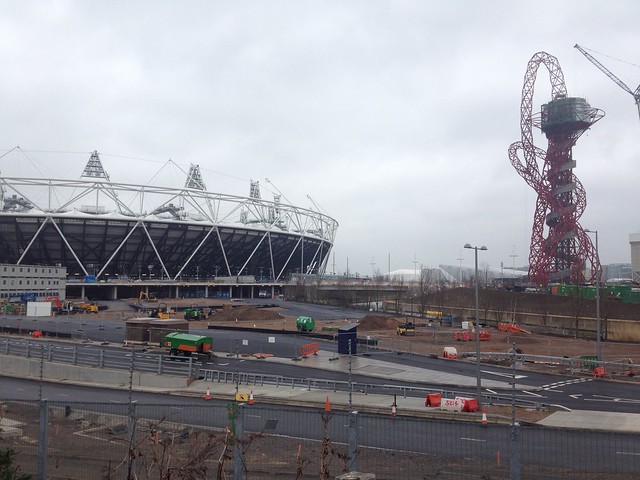
Not even running 100x25 back to back milers will get you in there
So that was pretty difficult.
But I also loved the ridiculousness of running 25 miles, then going to work. And no-one knows what you have just done.
I sat there at my desk inhaling food, giggling to myself at just having run slightly under a marathon and then coming to work as if nothing had happened.
However, having to then get up the next day and run 25 miles again. And then get up the next day and run 25 miles again I wasn't giggling to myself. Particularly in the howling rain on top of Hampstead Heath day 3 at round mile 11. Oh I was not laughing then.
Day 1 was positively fun. The previous week I'd been struggling a little with left knee issues, which had been affecting my whole left leg. My hip hurt. My calf ached, My ankle was stiff. I decided to go see a sports massuer who told me how to tape my knee to give it some support. This worked a treat for me. I don't know if it was psychological or physical, but I don't care. It's a helpful "plan B" option if my knee wants out in the desert.
Anyway day 1. Great knee, great weather, great route, great company (better half). Absolutely loved running down the canal to the Limehouse basin then back up along the Thames. Brought back London marathon memories! Felt good. It took 4 and a half hours - which is way too quick for marathon des sasbles but just felt right on the day.
Day 2 was a different matter. I didn't tape my knee up and it whinged at me all the way round. I also ran (apologies now East Londoners) what I call the grim route. Anywhere around Olympics site/Stratford/Lea Valley/Capital Ring heading East. *Shudder*. Even Victoria Park. The better half also took delight in telling me we had run on top of one of London's main sewer channels. How nice!
I think I don't like running around there as it's always grey weather when I do, and I'm always in that no mans' land territory of half way through a long run.
Anyway I was in a bad place unfortunately and because of my knee I had to walk the last 10k home. The relief though! of getting home was worth it.
All in all took over 5 hours.
Day 3. Oh the mental strategies needed to get myself out the door! I was starting to suffer a little from tight Achilles and a pulled hip muscle. However these did strangely disappear during the day. Probably got fed up of my moaning.
I've been lucky enough to have trained throughout the winter without coming up against any bad weather (bar the snow, but that's pretty). Day 3 of the 25 miler back to back was the exception. Crap weather.
Grey, windy, wet. Grim.
There were periods of running and laughing so hard it hurt at the silliness of it all. These, unfortunately, were few though. Mostly it was a case of disappearing inside myself and just getting on with it and trying not think about it. Or moaning at the other half.
I had to go home half way round as I was just soaked through and getting hypothermia (slight over exaggeration). However, getting changed into dry, warm clothes did wonders for my mental attitude and I stormed the last 10 miles (round and round and round and round and round and round Finsbury Park). Another 5 hour run.
I could not have done this without my better half. He's the most irritatingly sunnyside up, positive person I know. So I'm sorry for giving you the Death Stare when you told me "PMA, PMA!" on top of Hampstead Heath Day 3.
It has also told me I need to sort out my mental strategy for marathon des sables. What am I going to do when the going gets tough, I hurt, I get bored, and I want to give up? How am I going to deal with that?
I'm hoping it will be different in the desert. There will be no rain. There will be no boring, run-before-a-million-times routes. There will be no other tasks I'm worrying about doing when I've finished the run. There will just be me (and 999 others) and the desert.
But I must make sure I enjoy it. That's the point right? How amazing it is that I can run, and that I have got the opportunity to do this. How amazing it is that I have the chance to raise money for three very worthy causes and make a tiny difference. I must remember that.
I cannot wait.
Wednesday, 29 February 2012
The hills are alive with the sound of...runners' feet
View from North Downs just West of Dorking...in mid February!
Sticking with theme of offroading in new and exciting places in and around London took me and the other half to Dorking to run on the Surrey Hills.
I'm in love with the place. There is something about big open spaces that I'm drawn to (hoping this will add to my enjoyment of marathon des sables, being rather big and open).
Added to the beauty of the place was that the sun decided to join us. Positively balmy! Running past vineyards made me feel like I was in France, not Southeast England in February.
For the marathon des sables training plan I'm trying to fit in more challenging runs than flat roads in London, so the North Downs was perfect. It has hills. It has mud.
What hill training happened?
Saturday was an extremely hilly 10km up and around Box Hill. Now most people generally take the well marked trail path or road up to the top of Box Hill. Not me. My other half decided the right path was one that looked suspiciously like a wrong path. We ended up scaling the sharp end of Box Hill instead.
I could go on about men and directions, but I'm not going to. I'm just going to put this paragraph in bold instead.
Climbed up this. Rock climbing equipment not to hand.
On the plus it worked my calves out like nothing else. It was probably coming up for a 65-70% incline so it was a case of scrambling and holding onto tree roots to scale it's heights...
And not looking down.
Considering I've now heard some of the sand dunes on the marathon des sables are pretty scary to climb, I reckon this "training" we did (aka got lost) was probably a good thing. I just wish I could get used to not being scared of heights!
Sunday was more of a horizontal affair, though still hilly. More like rolling woodland than in-your-face vertical incline which was a little more pleasant. We ran 20 miles west from Dorking along the North Downs Way.
Why should runners do hill training?
I've posted on my hill training previously, but to recap I'm trying to concentrate on hill training to build my strength, build my running fitness in general (so I can run further before I get completely worn out), and get my legs used to running up hills, as there are going to be a lot of dunes to crawl over in April in the big sahara race.
So I've been a lot of running in places like Ally Pally, Queens Woods and Hampstead Heath, but it's always good to get out of London sometimes - particularly for me at the moment. I am suffering from a severe case of LACK OF ENTHUSIASM FOR RUNNING.
The North Downs, I am glad to say, has revitalised my love of running. How could you fail to be happy out in somewhere like this? In mid February as well? Happy days.
Monday, 27 February 2012
Off road running around London: backpack wanted!
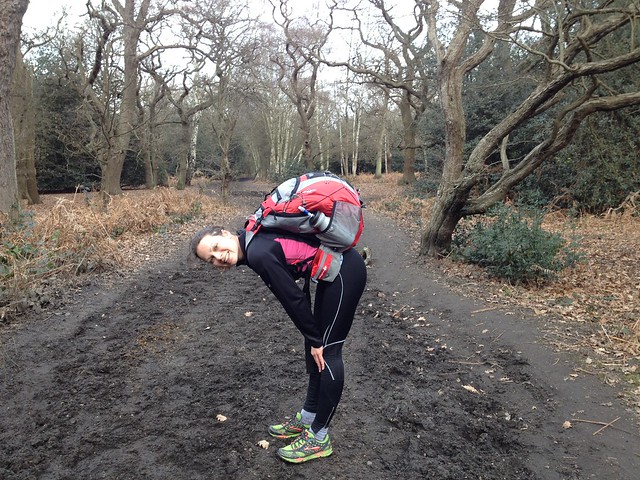
Best if you can at least stand upright Kate
So for the last couple of weeks I've started introducing a heavier backpack to my training.
Dear lord! It's heavy!
Some concerns floating around my head. Will my centre of gravity be altered so I fall over backwards? Will my shoulders fall off halfway round? Will I be able to even manage a shuffle anymore to beat the camel ok? (you get overtaken by the camels on marathon des sables and you are out!)
Who in their right mind would voluntarily add 4x packs of tuna and 2x cans of tesco value beans to their back to carry each day? Er...me it seems.
Because my left leg has been shouting at me the last couple of weeks I've been walking to work most mornings with said backpack. It's actually been rather pleasant. I generally plug myself into my headphones on the work route as its dull, but walking means you are going at a slower pace so see more London life and notice more things.
That said, you also get given the word of the lord too, but gives a bit of interesting reading along the way.
Walking with a heavy bag is one thing. Trying to run with one is another thing altogether. Last weekend the other half and I trekked over to Wimbledon on the Saturday and Epping forest on the Sunday. We didn't measure mileage, we just "ran" for 2 hours.
I'm not going to lie. I found it tough and I'm a bit nervous about doing that for a week. You get puffed out far sooner, your sense of balance is slightly knocked off course and your shoulders hurt to buggery. And that was just for 2 hours.
No matter. I will have to grin and bear it. Going to run a marathon this weekend with the full backpack to carry on trying to get used to it.
It was rather lovely running in new(ish) places. Both Wimbledon and Epping are offroad and a little muddy and a little hilly - about as good as we're going to get in London to mimic the desert conditions!
Was bitterly disappointed though that failed to spot either a womble or a TOWIE. Boo.
Tuesday, 7 February 2012
Sand dune training for marathon des sables
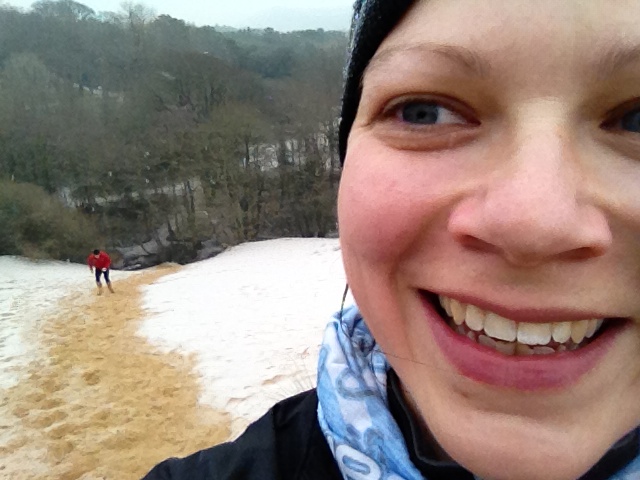
Yes it is ridiculous as it looks - but pretty funny
South of the sleepy unassuming town of Bridgend, South Wales lies the pretty sand dunes of Merthyr Mawr.
As well as being attractive they are also home to Europe's biggest sand dune - the big dipper. It's 245m long and I reckon 45 degree incline in places.
Which means....great training for marathon des sables!
View Larger Map
Map of Merthyr Mawr sand dune complex - A marks the village of Merthyr Mawr
The map above shows the region. The sand dunes range from about 3km wide to 5km across, so there is great scope for running a few circuits as well as specific dune training.
The dunes range from gently rolling to the huge big dipper. There is also a lovely stretch of flat sand to run across, which is also not very busy, as you have to get across the dunes to reach the sea - so it's just a really beautiful area to go running.
And easy on the old joints too.
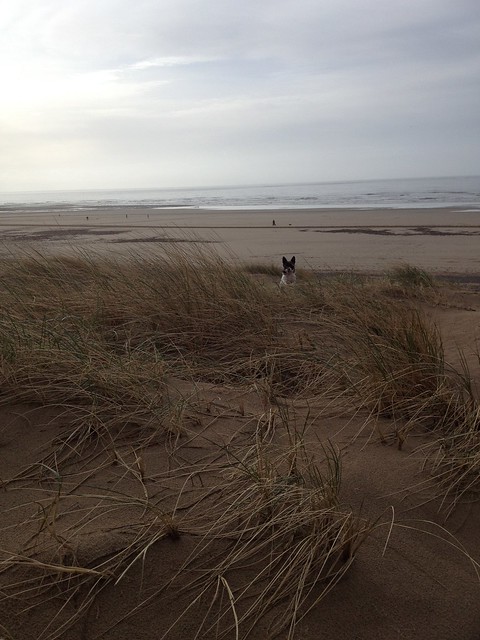
Very pretty (nice dog called Rolo too)
I managed three sessions there.
Day 1 - short, sharp dunes x10
Found a really steep dune and ran/slid/fell up and down it (and how fun is it to run down a sand dune? Feels like you are wearing springs)
Day 2 - medium dunes x20
Up and down a steeper dune in the snow.
Completely ridiculous but pretty good fun as well!
Day 3 - the big dipper x10 plus a circuit of dune network (maybe 2 miles total)
I have no one to compare against but to put into context I managed to jog up the whole way of the big dipper only once out of 10 times. The other nine was a combination of half jogging and half walking. It was really, really difficult.
My other half fared a little better than me, but also struggled to run the whole thing in one go too.
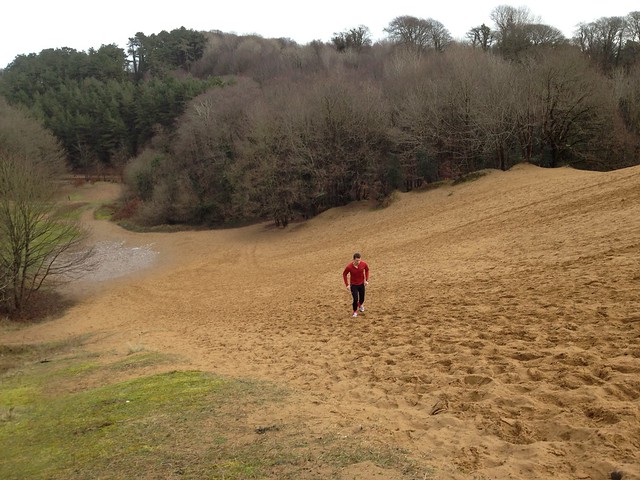
Come on slacker I finished ages ago. Tsk.
How did the gaiters fare?
I've got Sandbagger long gaiters. Happy to say they worked really well.
I had next to no sand in my shoes after pounding up and down in deep sand.
I only velcroed them to my shoes, and the velcro was only held onto the trainer with superglue, as I haven't figured out the stitching option yet. Stitching is essential though as the velcro would have definitely come off after a full day out there, but it was fine for a few hours here and there.
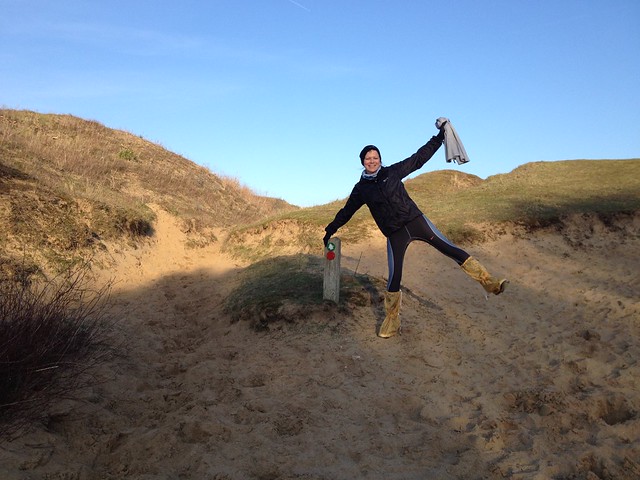
Happy face with gaiters
I also tried the shorter Raidlight gaiters too and these also seemed good.
I prefer the Sandbaggers though as they are really easy to put on and take off, whereas you need to take off your trainers first to get the Raidlight gaiters on, which may prove a little annoying after a while.
My other half had more troubles with sand. We worked out this was to do with his footwear, not the gaiters (as I tried his). He has inov8 Roclite 285 trainers , which are very lightweight but a little "holey". Whereas my Brooks Cascasdia 7 tend to let less sand through the air holes!
How to run up sand dunes?
Well, it's a bit of an oxymoron but the secret is to walk! Or at least take a slow, controlled jog up there.
I found that trying to leg it up sand dunes gets you nowhere, and tires you out.
The other half and I played around a bit and timed us walking versus "running" up the dunes, and it made a tiny bit of difference jogging up but not much compared to a steady walk. Plus you are exhausted at the top if you try and run the whole way, rather than being able to carry on and recover on the move.
Running up also seemed to dislodge more sand meaning you could end up slipping backwards instead of travelling forwards!
Finally, walking/short jogging strides meant you could work on a better foot placement. Following another's footprints in the sand is much better than digging your own trail up a dune. The sand is more compact where someone else has trodden so you can get a bit more traction and grip.
Position wise I found I couldn't look up as it overbalanced me - yes it was really that high! It also messed with my morale as the dunes look so steep from the bottom.
I found it easier to try and keep upright and maybe look a few steps ahead (maybe 1 metre or so) so you could see the next few strides to take. This was better than concentrating directly on the next footstep, as that meant you pitched yourself forwards too much, and I can imagine that would cause bad backache after a few hours.
All the time thinking strong core! strong core! Abs of steel! Abs of steel! Feeling like Rocky! Feeling like Rocky! Not about to die! Not about to die!
The other point to consider are walking poles. I don't have them, but I did think they would have been really, really helpful to get up the dunes. They help with balance and obtaining some grip.
Yes finished!
Other sand training options for marathon des sables
There is lots of good sand training options if you have more time or scope to train on sand including...
Reps up and down different sized dunes (as per moi)
Create a big circle half way up a dune and run around and around it
Circuits around different sand densities - from stony, sandy ground to deep sand
Circuit type training - side, back running, hops over objects etc
Logistics if you go to train at Merthyr Mawr
You can easily stay in Bridgend even if you don't have a car, and jog the 2.75 miles down to the start of the dunes every day. It's a pleasant jog through the edge of Bridgend, and down a country road through Merthyr Mawr village.
However, I would recommend taking a car if you have access to it, as it means you can solely concentrate on dune sessions rather than spending time jogging there and back. It also means you can do two sessions in a day, as you can leave for lunch and come back later.
All this would be fine as well without a car if the weather is good as you could take a picnic - but it was snowing when we were there and bitterly cold, so hanging around was unfortunately not an option.
There are no pubs or cafes in Merthyr Mawr village, but there are a couple of options in Ogmore, the next village along, if you do stay out there all day and it's too cold to be outside the whole time.
There is a car park for those who have a car, and basic toilet facilities, but not a lot else so make sure you have everything you need!
Subscribe to:
Posts (Atom)
